See Approvals
Coverage
Expert labor attorneys providing the highest level of service through a systematic system.
Musculoskeletal
Lung Disease
Work-related Cancer
Cardiovascular·Overwork
Hearing Loss
Pneumoconiosis
Suicide and Mental Disorders
Seafarer's Accident
Musculoskeletal Disorders
Confirmation of Diagnosis Name
Proximate Causation Between Work and Injury
Key Occupational Factors Contributing to Musculoskeletal Diseases
Q.
Can I receive compensation even if I have worked at multiple jobs, including daily labor?
A.
Yes, you are eligible. You can receive industrial accident compensation for the damage caused by musculoskeletal disorders if you have performed similar tasks continuously,
no matter how many worksites you have worked at.
Q.
Am I also eligible for industrial accident compensation even after I retire?
A.
Yes, you are. You do not have to be currently employed to be eligible for industrial accident compensation. However, if you retired a long time ago,
the causal relationship with job exposure may be weakened. So, we recommend that you should consult a certified public labor attorney(CPLA) on that aspect.
Q.
According to hospitals, I cannot file for occupational disease when the diseases are degenerative types.
Can degenerative diseases be covered by industrial accident compensation?
A.
Yes, they are covered by the compensation. Even typical degenerative diseases, such as stenosis or degenerative arthritis,
can be covered by industrial accident compensation if the relationship is clearly established with aforesaid types of tasks putting strain on the body.
Lung cancer and lung diseases
Lung Cancer
Leukemia
Malignant Mesothelioma
In addition, the Industrial Accident Compensation Insurance Act recognizes laryngeal cancer, ovarian cancer, sinonasal cancer, skin cancer, bladder cancer, liver cancer,
colorectal cancer, stomach cancer, and breast cancer as occupational cancers.
(Article 34, Paragraph 3, [Annex 3] of the Enforcement Decree of the Industrial Accident Compensation Insurance Act)
What are the principles for evaluating occupational relevance?
Latency Period
Application
Special Medical Examination
Occupational History Investigation
Request for Consultation and Judgment on Occupational Diseases to Advisory Bodies
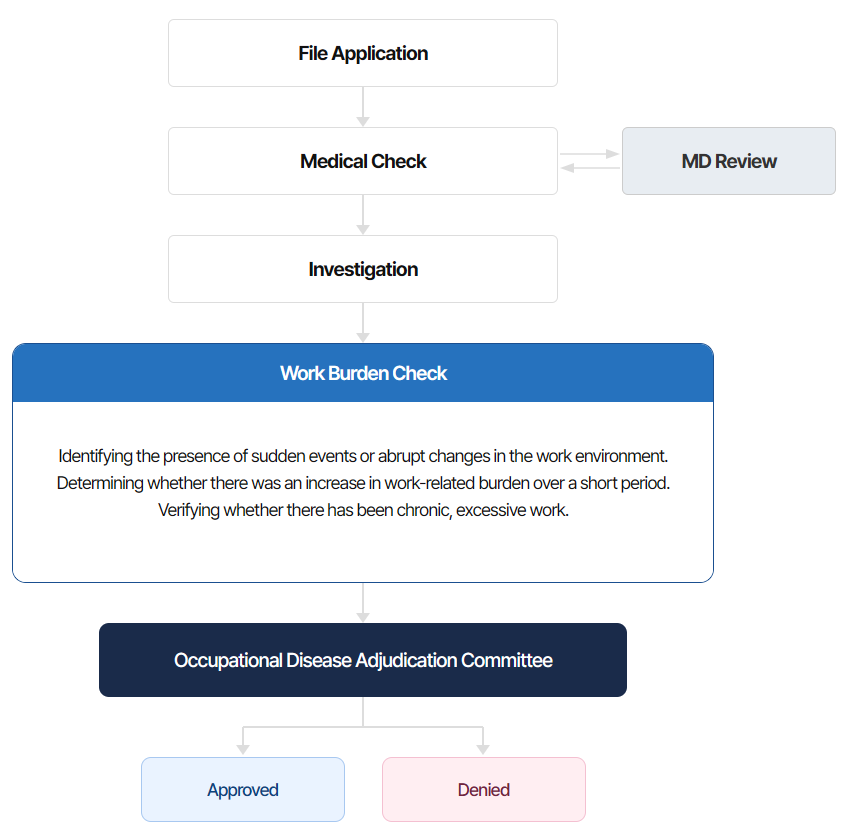
After preparing the investigation data and attaching relevant materials, the Occupational Disease Adjudication Committee determines whether there is a connection to the work. Subsequently, the affiliated organization decides whether to approve or disapprove based on the deliberation results of the Occupational Disease Adjudication Committee and notifies the applicant.
Occupational Cancer (Leukemia)
Occupational Cancer (Mesothelioma)
What is Occupational Cancer?
What are the characteristics?
Overwork-Related Diseases
Cerebrovascular Diseases
Heart Diseases
Confirmation of the Diagnosis
Substantial Causal Relationship Between the Disease and Work
Verification of Pre-existing Condition
Sudden Overwork
Short-term Overwork
Chronic Overwork
Swipe to view the full table.

Noise-Induced Hearing Loss
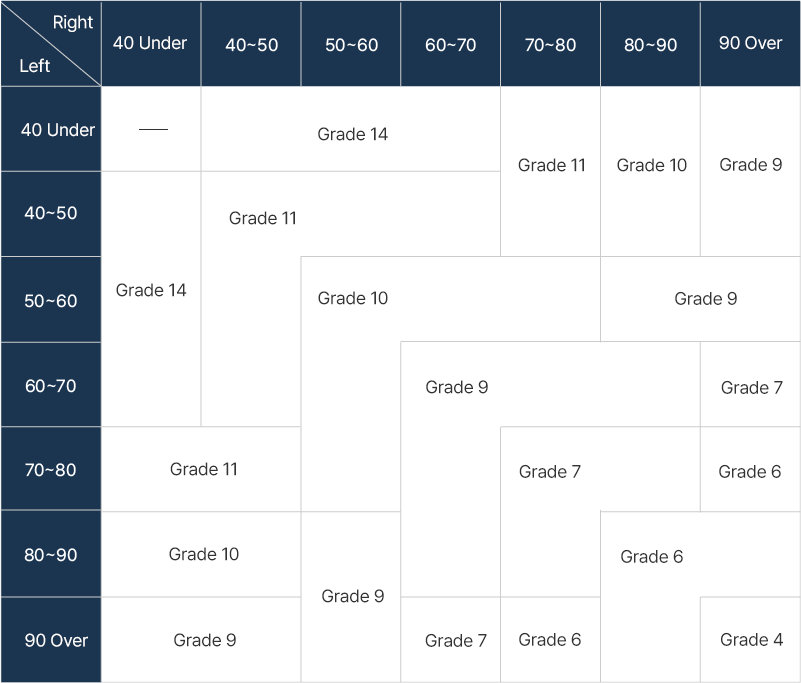
Exposure to continuous noise of 85dB or higher for 3 years or more.
Hearing loss in one ear must be 40dB or more.
Sensorineural Hearing Loss due to Inner Ear Lesions
Swipe to view the full table.

Q.
Can I only be recognized for industrial accidents if I have worked at only one workplace?
A.
Even if you have moved between several workplaces, it is not a problem to be recognized for an industrial accident as long as you have been exposed to similar noise. However, the condition that the workplaces must be subject to the Industrial Accident Compensation Insurance Act must be met.
Q.
Must I be currently employed for the accident to be recognized?
A.
Noise-induced hearing loss falls under the category of occupational diseases. In other words, since it appears due to the accumulation of noise, being retired does not mean you cannot be recognized for an industrial accident.
Q.
Is it only possible for tasks that directly generate noise?
A.
The noise referred to in the hearing loss recognition requirements meets the criteria for noise-induced hearing loss if the noise generated at the site is 85dB (decibels) or higher, even if your actual task does not generate noise. For example, if you are a formwork carpenter but work next to tasks involving grinders or rock drills at a construction site.
Q.
Does it also apply to sudden hearing loss?
A.
Hearing loss caused by a one-time loud blast or similar noise is considered sudden hearing loss. Unlike noise-induced hearing loss, which is an occupational disease, this must be processed as an occupational accident (accident-based).
Pneumoconioses
Swipe to view the full table.
| Type | X-ray Findings | |
|---|---|---|
| Suspicious | 0/1 | The density of small rounded or irregular opacities in both lungs is lower than the lower limit of Type 1. |
| Type 1 | 1/0 | A small number of small rounded or irregular opacities in both lungs, with no large opacities recognized. |
| 1/1 | ||
| 1/2 | ||
| Type 2 | 2/1 | Many small rounded or irregular opacities in both lungs, with no large opacities recognized. |
| 2/2 | ||
| 2/3 | ||
| Type 3 | 3/1 | A very large number of small rounded or irregular opacities in both lungs, with no large opacities recognized. |
| 3/3 | ||
| 3/+ | ||
| Type 4 | A | Cases where large opacities are recognized. |
| B | ||
| C |
Swipe to view the full table.
| Criteria for Degree of Cardiopulmonary Function | X-ray Findings |
|---|---|
| Severe Impairment (F3) |
Cases where FVC or FEV1 is less than 45% of the predicted normal value. (For FEV1, it must be less than 70% of FVC. The same applies hereafter in this item.) |
| Moderate Impairment (F2) |
Cases where FVC or FEV1 is 45% or more and less than 55% of the predicted normal value. |
| Mild Impairment (F1) |
Cases where FVC or FEV1 is 55% or more and less than 70% of the predicted normal value. |
| Slight Impairment (F1) | Cases where FVC (Forced Vital Capacity) or FEV1 (Forced Expiratory Volume in 1 second) is 70% or more and less than 80% of the predicted normal value. |
Swipe to view the full table.
| Cardiopulmonary Function Classification | Normal(F0) | Slight(F1/2) | Mild(F1) | Moderate-Mild(F2) | ||
|---|---|---|---|---|---|---|
| Small Op. | Type 1 | 1/0, 1/1, 1/2 | Grade 13 | Grade 11 | Grade 7 | Grade 3 |
| Type 2 | 2/1, 2/2, 2/3 | Grade 11 | Grade 9 | Grade 7 | Grade 3 | |
| Type 3 | 3/2, 3/3, 3/+ | Grade 1 | Grade 9 | Grade 7 | Grade 3 | |
| Large Op. | Type 4 | 4A, B, C | Grade 11 | Grade 9 | Grade 5 | Grade 3 |
| 4C 1/2 ↑ | ※ Regarding medical care, 4C and 1/2 are unrelated to cardiopulmonary function. | |||||
Active Pulmonary
Tuberculosis
Bronchitis
Bronchiectasis
Pneumothorax
Pleurisy
Emphysema
Cor Pulmonale
Primary Lung Cancer
Mycobacterial Infection
COPD
Swipe to view the full table.
| Disability Grade | Compensation Amount (Average Wage x Number of Compensation Days for the Corresponding Grade) |
Degree of Pulmonary Function Impairment in Chronic Obstructive Pulmonary Disease (COPD) |
|---|---|---|
| Grade 3, No. 4 | Average Wage x 1,155 days | FEV1: 30% or more and less than 55% |
| Grade 7, No. 5 | Average Wage x 616 days | FEV1: 55% or more and less than 70% |
| Grade 11, No. 11 | Average Wage x 220 days | FEV1: 70% or more and less than 80% |
Suicide and Mental Disorders
Proving occupational stress factors and severity
Identifying non-work stressors and personal characteristics
Proof of a history of mental illness treatment and abnormal mental state
Fisherman accidents
Swipe to view the full table.
| Type | Reason | Details of Benefit | |
|---|---|---|---|
| Occupational | Non-occupational | ||
| Medical Care Benefits | In case of injury or disease occurred during or outside of official duties | Full amount of medical care expenses | Medical care expenses for up to 3 months(However, not paid in cases of intentional acts or gross negligence) |
| Sickness Benefits | In cases where workers are receiving medical care due to occupational or non-occupational injury or diseases |
Within 4 months: Ordinary wage | 70% of ordinary wage for up to 3 months only (However, not paid in cases of intentional acts or gross negligence) |
| After 4 months: 70% of ordinary wage | |||
| Disability Benefits | In case a disability remains even afterrecovery from an occupational injury or disease |
Average onboard wage x Standards under the Industrial Accident Compensation Act | X |
| Lump-sum Compensation Benefits | If not recovered even after 2 years of occupationalmedical care (injury & disease) benefits |
1,474 days of the onboard average wage | X |
| Survivors' Benefits | In case of death during or outside of official duties (including death during medical treatment) |
1,300 days of onboard average wage | 1,000 days of onboard average wage (However, not paid in cases of intentional acts or gross negligence) |
| Funeral Expenses | In case of death during or outside of official duties |
120 days of the onboard average wage | 120 days of the onboard average wage |
| Missing Persons' Benefits | In case the life or death of a fisherman, etc., is unknown |
1 month of ordinary wage and 3 months of onboard average wage (After 1 month: Additional survivors' benefits and funeral expenses are paid) |
| Personal Effects Loss Benefits |
In case of loss of personal effects due to a fisherman's accident while onboard | Equivalent value of the lost items (Within the limit of 2 months of ordinary wage) |
Equivalent value of the lost items (Within the limit of 2 months of ordinary wage) |

Commuting Accidents